
PHYSICS
Why choose Physics?
Choosing A Level Physics is an excellent option if you are curious about how the universe works and enjoy tackling challenging problems using logical reasoning and mathematics. Physics helps you develop a deep understanding of the fundamental laws that govern motion, energy, forces, waves and matter, from sub-atomic particles to the largest structures in the universe. You will learn to model real situations mathematically, analyse data critically and apply abstract ideas to practical contexts – skills that are highly valued by universities and employers across many sectors.
A Level Physics is both demanding and rewarding, combining theoretical concepts with practical investigation. In the laboratory, you might explore electrical circuits, investigate motion and forces, analyse waves and radiation, or determine physical constants using precise measurements. As your understanding develops, you will see how Physics underpins major real-world technologies and global challenges such as renewable energy generation, medical imaging, communications, space exploration and climate modelling. Studying Physics equips you with exceptional problem-solving, mathematical and analytical skills, keeping a wide range of future pathways open.
Physics works especially well with:
-
Mathematics (engineering, theoretical physics, data science)
-
Chemistry (materials science, physical chemistry, energy)
-
Biology (medical physics, biomechanics, imaging)
-
Computer Science (modelling, simulation, artificial intelligence)
This makes Physics A Level a rigorous, highly respected and versatile choice for students aiming for STEM degrees and a wide range of scientific, technical and professional careers.
 Entry requirements and expectations
To study A Level Physics, students are expected to have a strong foundation from GCSE. We require a minimum of Grades 7–7 in GCSE Combined Science or a Grade 7 in GCSE Physics separate Science. In addition, students should be confident in GCSE Mathematics, as the course involves a significant amount of algebraic manipulation and problem-solving. These requirements indicate that you have the scientific understanding, mathematical competence and analytical skills needed to meet the demands of the course.
A Level Physics builds significantly on GCSE work. While the content is more detailed and conceptually challenging, the biggest change is in the way you are expected to learn. You will be required to take increasing responsibility for your own progress by revisiting topics independently, practising mathematical skills regularly, and developing accurate experimental and data-analysis techniques. The course not only deepens your understanding of physical principles but also prepares you well for university study through its emphasis on logical reasoning, precision, and independent learning.
What to expect with physics at Bexley Grammar School
All of our Physics teachers are experienced A Level specialists, and you will be taught by two teachers across the two-year course. You will have opportunities to apply to become a Science Prefect or Science Leader, take part in national Physics competitions such as the Physics Olympiad, and attend enrichment events including the Physics in Action trip, where you can experience university-style lectures delivered by leading scientists and researchers.
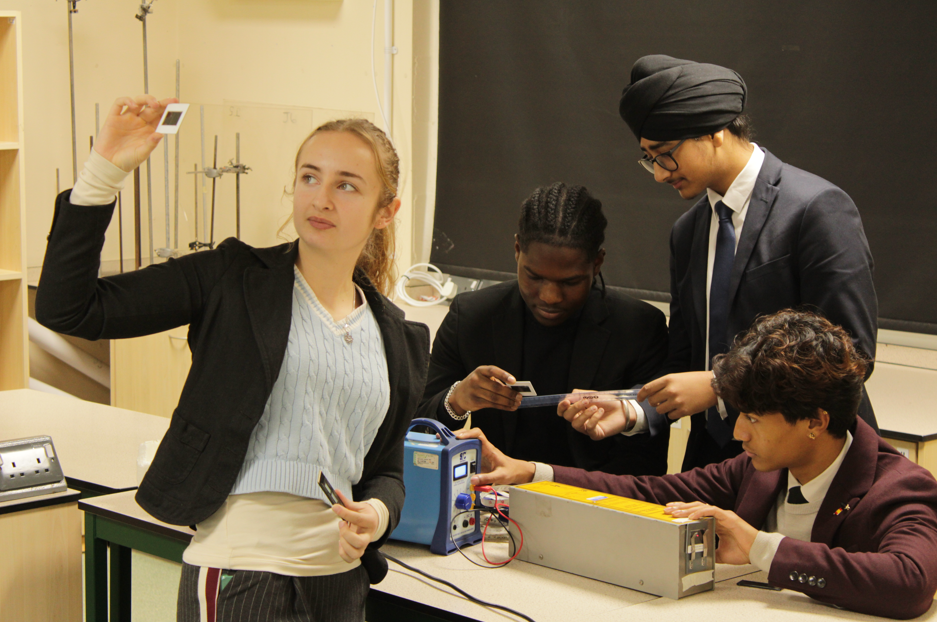
Practical work is a central feature of the course, with regular laboratory sessions involving precise measurement, data analysis, and investigative experiments across topics such as mechanics, electricity, waves and fields. You will make use of specialist equipment and develop strong experimental and analytical skills. These experiences are designed to build confidence, accuracy and enthusiasm for Physics, while preparing you thoroughly for further study and careers in science, engineering and technology.
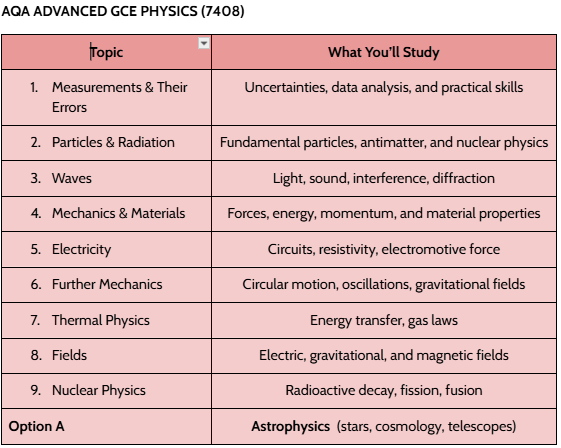
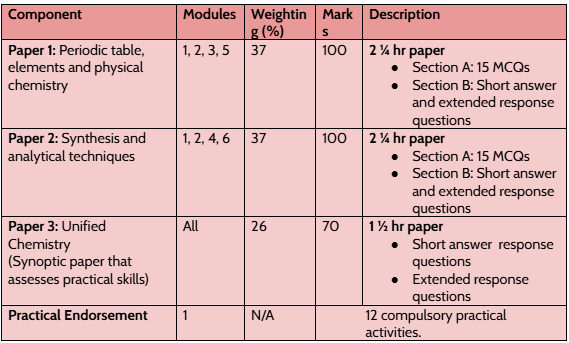
External assessments take place at the end of the two year course. Students must complete all components to be awarded the AQA A Level in Physics.
-
Additionally, there are regular internal assessments, including end of topic assessments, as well as Year 12 and Year 13 mock exams.
-
The style of the papers is varied, including multiple choice, short answer and extended answer questions.
-
There will be questions linked to practical skills in the written exams.
Experimental programme for Physics
Practical work is a fundamental part of A Level Physics, allowing students to test physical laws and explore theoretical ideas through direct investigation. By carrying out a wide range of experiments, students develop their understanding of topics such as mechanics, electricity, waves, fields, and nuclear physics, while learning how physicists collect and interpret evidence.
Students are taught how to plan and carry out investigations methodically, use specialist apparatus with confidence and care, record results accurately, and analyse data critically. They also learn to evaluate experimental methods, consider sources of uncertainty, and suggest improvements. These skills encourage independence, logical thinking, and resilience, all of which are essential for success in Physics and beyond.
The AQA specification requires students to complete a set of compulsory practical activities throughout the course. Although the Practical Endorsement is reported separately from the final A Level grade, it plays a crucial role in preparing students for written examinations, where questions regularly assess practical techniques, experimental design, and data analysis. Strong engagement with practical work therefore directly supports achievement in A Level Physics and provides an excellent foundation for further study in science or engineering.
Enrichment Opportunities
-
National competitions such as Physics Olympiad
-
Science leadership roles.
-
Interview practice.
-
Support with university entrance exam (e.g. PAT)