
A reflection from the Senior Science Society: 1 light-day

Last week, on the 18th November, Voyager 1 crossed the major threshold of one light-day’s distance from humanity; that is, the distance light–and any communication travels in the span of 24 hours.
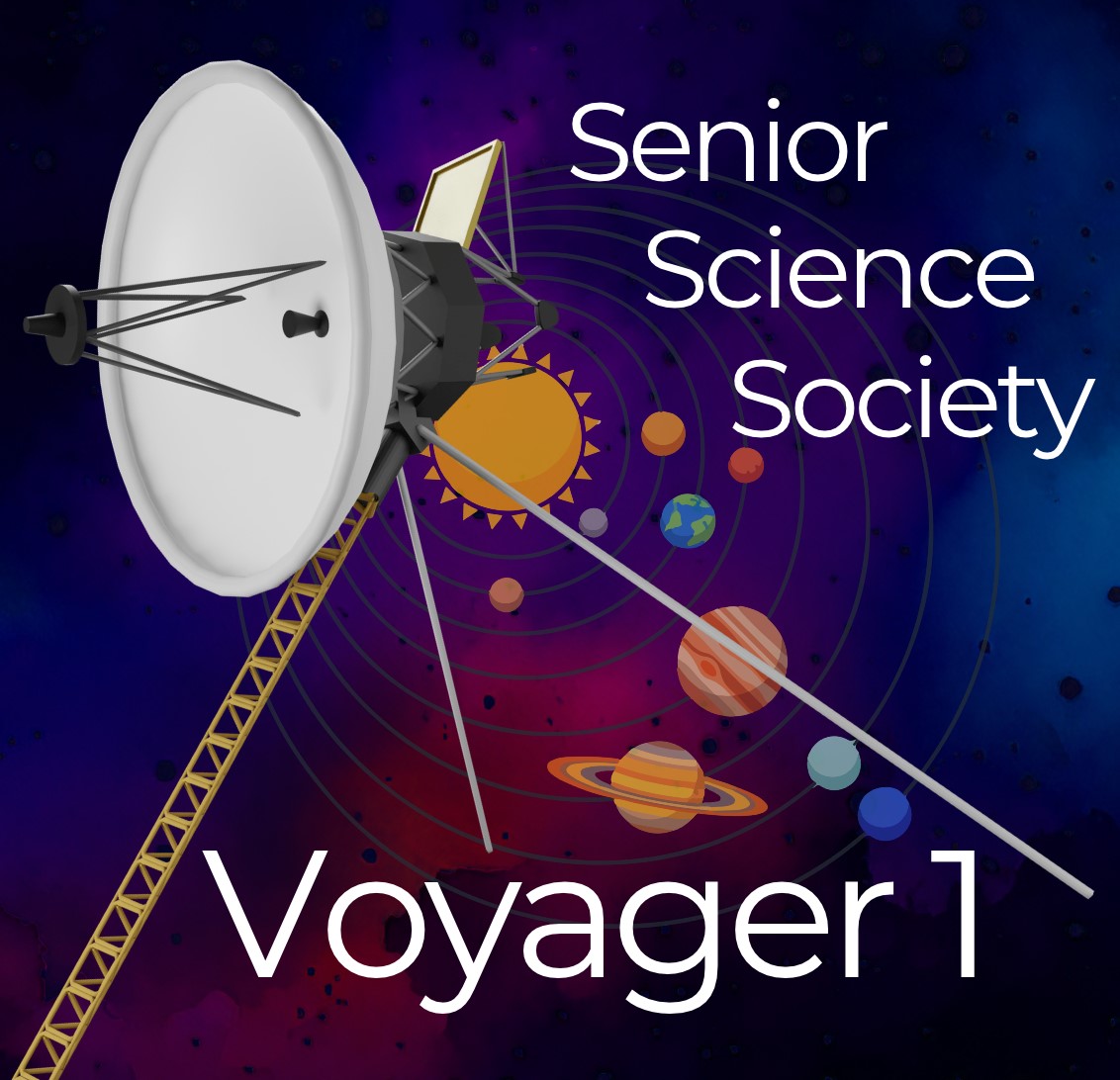 24 hours is one rotation of our frail planet; the time it takes us to awaken, go about our lives, work, connect with one another and sleep again. It is within that time that light travels the ~16 billion miles to the vessel, and it is not difficult to appreciate the profound sense of scale in what lies beyond our world.
Many would feel profound grief at the sheer isolation of its journey. Voyager 1 launched in September 1977. It predates the lives of many of us, and will likely physically outlive the day when our technology can no longer sustain contact. Originating in the human ambition of the human era, the latter part of its journey is ultimately marked by the isolation of interstellar space, with its final aim, to record and honour civilisation, remaining uncertain.
The sustaining force of its journey lies in a fascinating piece of technology, the radioisotope thermoelectric generator (RTG), favoured for reliability, as it operates without any moving parts.
A unit utilises unstable atoms of plutonium-238, which decay gradually, emitting radiation (α) and releasing heat energy. Subsequently, the temperature difference across a “thermocouple”, formed of two metal plates at its core, generates electricity, powering the space probe. This isotope was favoured for its ability to densely store energy and moderate half-life (88 years), allowing it to output consistently and sufficiently for decades of service.
This technology powers everything from the last images taken of Earth to communications and scientific instruments. At launch, the power output was 158W per (3) RTGs; just under ⅕ of the average household microwave’s power consumption. As the supply of radioactive isotopes depletes, the power gradually decreases, prompting equipment to be switched off on the probe, including both cameras in 1990.
Within a year of launch, in 1978, Voyager 1 studied the turbulent atmosphere of Jupiter, harnessing the alignment of Jupiter and Saturn in their orbits and the planetary gravity to fling above the plane of the solar system. Among these planets, data and observations enabled us to better understand their ring and planet systems, as well as potential pre-biotic (before life) formation of carbon compounds on Titan, a moon of Saturn. Its current flight is at around 17.0 kilometres per second, with little external forces acting upon it.
In the vast 49 years since it left its home, what has happened? Generations have grown up, many are no longer with us. We have fallen in love, invented the internet, made art, destroyed and waged war. Ultimately, the last thing Voyager 1 will carry is the record we fixed to it back then – the Golden Record, a collection of phonograph records. They collectively record, in images, a portrait of life, creativity and harmony on Earth, including, most prominently, a mother’s love for her child. In audio, greetings in 55 languages, birds, rain, crickets and frogs, and music including Otto Klemperer conducting Beethoven's 5th symphony. Etched onto its surface, the playing instructions, including rotation speed, expressed in units of atomic time, in the hope that theoretical distant life may come to understand what we express.
Despite the outward-looking goals of the scientific feat, the infinite journey’s most powerful message remains in its backward glance. In February 1990, prior to being switched off forever, the Voyager’s cameras pointed lastly at the Earth, at an enormous distance, recording the famous image of it, the "Pale Blue Dot."
Comfortable on our home planet, it may be hard to imagine the scale which diminishes it to a barely distinguishable speck. Nonetheless, it serves as a powerful reminder of how fragile existence itself really is, and yet how important it is to hold onto and care for what we have. To quote planetary scientist Carl Sagan, “There is perhaps no better demonstration of the folly of human conceits than this distant image of our tiny world, [ . . .] To me, it underscores our responsibility to deal more kindly with one another, and to preserve and cherish the pale blue dot, the only home we've ever known.” The mission’s ambition speaks, in part, to our unity and dependence on one another and the planet for our lives, and ultimately that humanity can, and must be, humble "voyagers" against aims of power and destruction.
The Senior Science Society