
Holocaust Memorial Day - 27th January
Students at Bexley Grammar School have been learning about the Holocaust this week in line with Holocaust Memorial Day on January 27th. January 27th 1945 was the date that the biggest Nazi concentration camp, Auschwitz-Birkenau, was liberated by Russian troops, bringing to an end the systematic murder of Jewish, Gypsy, LGBT and other people in that part of Poland. The Holocaust claimed the lives of over 6 million people and affected millions more. Students have been learning about the stories of some of the individuals who were affected by the Holocaust in their English, FBCS and History lessons and some of their work is shared below.
Thanks to all the staff who enabled this and delivered the material to students. Thank you to all of the students who participated and contributed their ideas.
Mr Martin, History Teacher
Gena Turget- Birth 1923
1st September 1939- her house was first bombed
Autumn 1941- moved to the ghetto in Krakow
1944-45 sent to Auschwitz
January 1945- sent on trucks to Bergen Belsen
15th April 1945– Bergen Belsen was liberated
Gena was only 16 when her house was bombed at the beginning of the war, which meant she then had to move to a ghetto where some of her family were shot. When they were found they were forced to constantly move from one camp to another until she was finally liberated in 1945, with only her Mother left as her remaining living family.
We need to remember these stories, so it reminds us of this despicable crime and not to do it again. Gena helps us remember that not only adults, but children who were brought up in Judaism were taken to concentration camps too, and that genocide is a despicable crime which should never happen in large or small numbers ever again. From her experiences she has written a book “I light a candle”.
Jessica Davis, Year 7


Aaron Kiley, Year 9

Emilia Morgan, Year 9
Reine Inow
Born: 1929 in Germany
Lived with: her mother, her father, her brother and her sister

Reine Inow was born in Germany and was a Jew. When she was 10 years old, her brother was taken to a concentration camp and she was sent away to Britain by the Kinder transport - a programme that helped children escape Germany to find a safer place to live. She arrived in England and stayed with her aunt. Reine managed to escape the holocaust, however, her parents sadly did not. She still lives in England and has ever since.
It’s important that Reine’s story is remembered because it helps us remember that not all Jews were killed in the Holocaust and that everyone can find hope in anything.
Layla Evans, Year 7

Alice Colaiacomo, Year 7

Hari Rehal, Year 8

Samuel Raji, Year 8
 ditionary Force. Lord Derby was the first to implement the idea of a “Pals” Battalion in Liverpool. Inside a week, there were enough volunteers to fill four battalions. The idea was that men would be more likely to join up if their pals also joined the war effort.
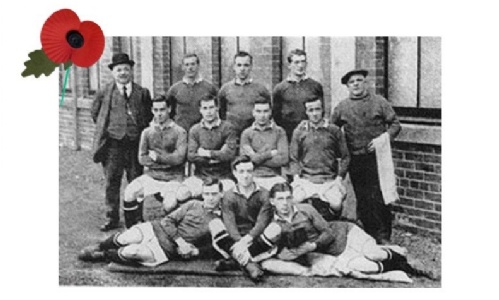
 es, and this included sports stars too. Clapton Orient’s (later Leyton Orient) players and staff joined the army, inspiring thousands of their fans to do the same. This is the story of Hearts of Midlothian. The 1914/15 season had started well for Hearts with 8 consecutive victories. However, with the war continuing, Hearts’ players and staff decided they should join the war effort on 25th November 1914. The players combined military and football training to go 20 games unbeaten and be top of the league by February. However, the double life began to take its toll on the players, often engaging on night marches the night before crucial fixtures. Most of the team were sent to France before the end of the season. This is the story of some of their players…
